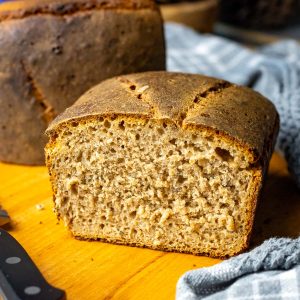
Lithuanian Rye Bread
There are few things more deeply rooted in Lithuanian food culture than Lithuanian Rye Bread. Dense, dark, and unapologetically sour, this sourdough rye bread isn’t just something you eat — it’s something you respect. Baked slowly, shared intentionally, and tied closely to tradition, Lithuanian bread has carried families through generations. This recipe is inspired by tradition, tested many times, and deeply nostalgic — the kind of bread that tastes better when you pause for a moment before slicing into it.
Equipment
- Kitchen scale sourdough requires a little precision
- Stand Mixer fitted with a dough hook attachment
- Loaf Pan (8.5 x 4.5 x 2.5 inches - 2 lb volume)
Ingredients
For Levain
- 200 g sourdough starter unfed, but not old*
- 200 g whole rye flour a.k.a. dark rye flour
- 100 g lukewarm water*
For The Dough
- 500 g active levain all of the mixture you prepared yesterday
- 100 g dark rye flour
- 120 g strong bread flour wheat flour
- 1 tablespoon caraway seeds
- 3 tablespoon granulated sugar
- 1 tablespoon honey
- 2 teaspoon salt
- 1 tablespoon malt extract optional
- 100 g lukewarm water*
Instructions
DAY 1 - Evening: Prepare Levain
- In a large bowl, combine sourdough starter, water and rye flour. Mix well until fully combined.
- Cover the bowl and leave it in a warm spot (around 24°C ( 76° F) for 12 hours (overnight).
DAY 2:
- Lightly oil and line a non-stick 2 lb loaf pan (8.5 x 4.5 x 2.5 inches) with parchment paper, leaving some overhang on the long sides for easy removal. You can use a non-stick round cake pan as well.
- Yesterday's mixture should have at least doubled in volume and look airy.
- To your sourdough levain, add both types of flour, sugar, honey, salt, caraway seeds and water. If using, add the malt extract too.
- Knead the dough in a stand mixer fitted with a dough hook attachment for 8-10 minutes. If kneading by hand, expect a sticky dough, so a slap and fold method works best here. You should end up with soft and cohesive dough that sticks to your hands a lot less.
- Scoop the dough into a lined loaf pan and flatten the surface with a rubber spatula.
- Place it in a plastic bag (ensuring the top doesn't touch the dough as it rises) and leave it in a warm spot (around 24°C (76° F)) for 4-5 hours, or until the volume increases by at least 50%.
- Preheat the oven to 240° C (465°F) (as high as most home ovens go).
- When the dough is proofed, score the bread with a sharp knife or a bread lame. and immediately place it in the oven. Bake the bread for 15 minutes. Then reduce the temperature to 200° C (390° F) and continue baking for another 30 minutes.
- The crust should be dark and the edges should be coming away from the pan.
- As soon as you take the bread out of the oven, remove it from the pan and spray with a little water to soften the crust.
- Place the bread on a wire rack and allow it to fully cool before slicing.
Video
Notes
1. Use unfed sourdough starter that hasn't been sitting in the fridge for over 2-3 days. Old discard, especially one that's forming hooch on top, will be too weak to raise the dough and make it taste too acidic.
2. Lukewarm water kickstarts the fermentation process, so if you're working in a very warm environment, use cold water - otherwise, the levain/dough will be overfermented.
Recipe from Lietuviška juoda duona | Malsena.